Smart Glasses Go to Medical School
From operating rooms to medical schools to mental health clinics, augmented reality glasses are quietly reshaping how care is delivered.
The lead surgeon at Stanford Medical Center is wearing what looks like an ordinary pair of glasses. They’re not. Floating in her field of vision are the patient’s CT scan, live vital signs, and a 3D reconstruction of the surgical site — all displayed without her hands ever leaving the operating field.
Smart glasses in healthcare look like this today: lightweight, unobtrusive, and increasingly central to how some clinicians work. While consumer audiences largely forgot about smart glasses after Google Glass’s rocky 2013 debut, clinicians saw something different — a hands-free computing platform for environments where sterility, speed, and real-time data access can mean the difference between a good outcome and a catastrophic one.
The technology has matured significantly. Modern medical smart glasses combine augmented reality overlays, high-resolution cameras, voice control, and wireless connectivity in frames that look increasingly like regular eyewear. Early clinical studies and reviews suggest these devices can sharpen surgical visualization, enhance procedural training, support medication management, and open new pathways for mental health monitoring and treatment, although large-scale outcome data are still emerging.
Smart Glasses vs. VR Headsets: Why the Distinction Matters in Medicine
Before going further, it’s worth clarifying a common confusion. Smart glasses and VR headsets serve fundamentally different clinical roles.
VR headsets like the Meta Quest and HTC Vive create fully immersive virtual environments. They’re valuable for surgical training simulations, pain management, and therapeutic interventions — but they replace your view of reality entirely.
Smart glasses augment what you’re already seeing. You can still see your patient, your instruments, and your team while digital information enhances your perspective. This is what makes AR smart glasses practical for real-time clinical care, whereas VR headsets are primarily reserved for training, therapy, and simulation.
How Smart Glasses Evolved from Google Glass to Medical-Grade AR
Google Glass’s 2013 consumer launch was widely seen as a failure. But in healthcare, it planted a seed. A wave of early adopters and startups built HIPAA-conscious applications that let clinicians livestream surgeries, access electronic medical information, and consult remotely — all through Glass’s lightweight frame. The hardware had limitations (overheating, poor battery life, a mediocre camera), but the concept proved sound.
Today’s medical-grade devices are a different category entirely. The Vuzix M4000 offers voice-controlled 3D holographic displays. Microsoft’s HoloLens 2 delivers advanced spatial computing for surgical planning. Newer entrants like the Vuzix Shield and Oakley Meta Vanguard are pushing the form factor toward something nearly indistinguishable from regular eyewear — which matters tremendously for patient comfort and clinical adoption.
The global medical smart glasses market reflects this trajectory. Industry projections estimate revenues will reach $4.1 billion by 2030, driven by demand from surgical departments, telemedicine platforms, and medical education programs.
Smart Glasses in Surgery: Real-Time AR Overlays and Remote Guidance
The operating room is where smart glasses deliver their most dramatic impact.
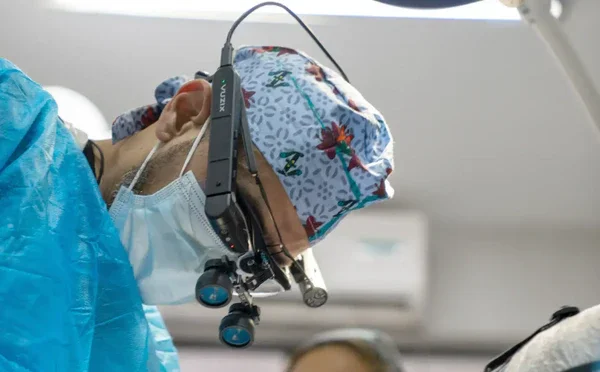
Traditionally, surgeons glance at wall-mounted monitors for imaging and vitals, or ask staff to hold tablets — breaking concentration, interrupting sterile workflow, and adding seconds that compound over hours-long procedures. AR-enabled smart glasses eliminate this entirely. Surgeons view patient imaging, real-time anatomy maps, and physiological data without ever looking away from the surgical field.
During complex procedures like tumor resections, surgeons using the Vuzix M4000 can overlay preoperative CT or MRI scans directly onto the patient’s body using voice commands or gesture controls. This capability — sometimes described as “X-ray vision” — allows precise navigation around critical structures like nerves and blood vessels. Specialties from neurosurgery to orthopedics and oral-maxillofacial surgery are adopting the technology.
Smart glasses also enable something that was previously impossible at scale: remote surgical guidance. An expert surgeon in Boston can see exactly what their colleague in rural Montana sees, providing real-time instruction overlaid in the operating surgeon’s field of view. This has profound implications for healthcare equity, bringing specialist expertise to underserved communities without requiring physical travel. Organizations like Ohana One are already using Vuzix smart glasses to connect surgeons across continents for live procedural guidance.
AR Smart Glasses in Medical Training and Education
Medical training has historically relied on a bottleneck: proximity. Students crowd around patients or cadavers, and only those closest get a clear view. Smart glasses are removing that bottleneck entirely.
When an instructor performs a procedure while wearing AR-enabled smart glasses, their first-person perspective can be livestreamed to an entire lecture hall of students on connected devices. Instead of twenty students jostling for position, hundreds can experience the same viewpoint simultaneously, with key anatomical features highlighted and labeled in their field of vision. Vuzix reports that surgeons using their glasses for education can broadcast 4K video and audio to students around the world during live procedures like open-heart surgery.
Medical schools are taking this further with anatomy education. AR glasses overlay digital anatomical structures onto physical mannequins or standardized patient models, transforming abstract textbook diagrams into three-dimensional, interactive learning experiences. Research suggests this approach significantly improves retention and spatial understanding of complex anatomy.
Perhaps most valuable is the technology’s ability to close the rare-case gap. Medical students might never encounter certain conditions during their training rotations. AR-powered simulations allow them to experience hundreds of clinical scenarios — building the pattern recognition and diagnostic instincts that traditionally take years of practice to develop.
AI-Powered Medication Error Detection with Wearable Cameras
One of the most compelling safety applications of smart glasses comes from the University of Washington, where researchers developed a wearable camera system that uses AI to automatically detect medication errors in operating rooms.
The system, tested with head-mounted 4K cameras worn by 13 anesthesiology providers across 17 operating rooms over 55 days, uses deep learning to detect and classify drug labels on syringes and vials in real time. The results were striking: 99.6% sensitivity and 98.8% specificity at catching vial swap errors — instances where a provider inadvertently fills a syringe from the wrong drug vial.
The scale of the problem this addresses is significant. Drug-related errors affect at least 1 in 20 patients in clinical settings, with error rates for drug delivery events estimated at 5–10% of all medications administered in hospitals. An AI system that catches these errors before they reach patients represents a meaningful patient safety intervention.
Smart Glasses for Mental Health: AI-Assisted Support for Depression and Anxiety
While surgical and training applications get the most attention, one of the most promising frontiers for smart glasses in healthcare is mental health treatment — an area where demand far outstrips available resources.
In the UK, the government recently announced £3.6 million in funding for 17 innovative projects using extended reality technology for mental health support, with smart glasses central to several initiatives.
CrossSense, a London-based company, has developed lightweight smart glasses that use AI to help people with severe depression complete everyday tasks. This addresses a challenge that clinicians recognize but technology has largely ignored: conditions like depression, anxiety, and psychosis significantly impair memory and executive function, making routine activities feel overwhelming. The CrossSense glasses provide real-time, context-aware prompts and encouragement — functioning as a kind of cognitive scaffold delivered through a discreet, wearable interface.
Challenges of Smart Glasses in Healthcare: Cost, Privacy, and Integration
For all their promise, smart glasses face real adoption barriers that healthcare systems must navigate.
Privacy and data security remain the foremost concern. Patients understandably worry about being recorded during vulnerable medical encounters. While medical-grade devices include visible recording indicators and operate under strict data governance frameworks (including HIPAA compliance in the U.S.), building patient trust takes time. Healthcare organizations must establish clear policies about when cameras are active, how data is stored, and who has access.
Cost and ROI justification present an ongoing challenge. Medical-grade smart glasses range from $2,000 to $3,500 per device, with additional costs for software licensing, IT infrastructure, and training. For resource-constrained healthcare systems, these investments require clear evidence of return — which is still being generated through pilot programs and early clinical studies.
Battery life and ergonomics are improving but remain limiting. Most devices operate for 2–4 hours before requiring a charge, which is problematic for long surgeries or full clinical shifts. (Vuzix claims its M400 supports 16+ hour surgical sessions, though this is an outlier.) Some users report discomfort during extended wear, particularly with heavier AR devices.
System integration is technically complex. Smart glasses must connect seamlessly with electronic health record systems, imaging platforms, and hospital Wi-Fi networks. These integrations often delay implementation and require dedicated IT support.
The learning curve is real but manageable. Early adopters report 4–6 weeks before voice commands and gesture controls feel natural. For time-pressed clinicians, this transition period can feel like a significant friction point.
FDA and EU Regulation of Medical Smart Glasses
The regulatory landscape for smart glasses in healthcare remains in flux, creating both caution and opportunity.
In the United States, the FDA has taken a measured approach. Devices used purely for visualization and communication — essentially acting as a display — generally do not require FDA clearance. However, when smart glasses incorporate diagnostic AI algorithms or actively guide clinical decisions, they may be classified as medical devices requiring formal regulatory approval.
In Europe, the Medical Device Regulation (MDR) has added complexity for manufacturers pursuing international markets, requiring extensive clinical validation and post-market surveillance.
This regulatory ambiguity has created a gray zone. Many developers proceed cautiously, waiting for clearer frameworks before investing heavily in clinical-grade applications. For healthcare buyers, this means conducting careful due diligence on which devices and software platforms have — and have not — received regulatory clearance for their intended use.
The Future of Smart Glasses in Healthcare: 2026–2030 Outlook
The trajectory for smart glasses in healthcare points clearly toward wider adoption and deeper integration. Here’s what to expect.
Within the next 1–2 years: Expect broader adoption in routine clinical care as device costs decline and battery life improves. Mental health applications will expand as UK pilot programs demonstrate measurable outcomes. AI integration will accelerate, offering real-time clinical decision support and more sophisticated behavioral pattern recognition.
By 2028–2030: Smart glasses may incorporate advanced biosensors capable of measuring vital signs through the frames themselves, becoming both a display and a monitoring device. 5G-enabled remote collaboration will enable medical students anywhere in the world to observe and participate in live surgical cases. And the devices will likely become nearly indistinguishable from regular eyewear, removing one of the last barriers to universal clinical acceptance.
The transformation won’t happen overnight. Healthcare moves deliberately, and rightly so — patient safety demands careful validation. But the direction is unmistakable. As clinical evidence accumulates, costs fall, and regulatory frameworks clarify, smart glasses in healthcare will shift from innovative to expected.
FAQ: Smart Glasses in Healthcare
What are smart glasses used for in healthcare?
Smart glasses in healthcare serve multiple functions: they display patient imaging and vital signs during surgery without requiring surgeons to look away from the operating field, enable remote specialist consultations via live video streaming, support medical training by broadcasting a clinician’s first-person view to students, and are emerging as tools for mental health support and medication error detection.
How much do medical smart glasses cost?
Medical-grade smart glasses typically range from $2,000 to $3,500 per device. Total implementation costs are higher when factoring in software licensing, HIPAA-compliant data platforms, IT infrastructure, and staff training. Costs are expected to decline as the market matures and more manufacturers enter the medical segment.
Do smart glasses require FDA approval for medical use?
It depends on the use case. Smart glasses used purely as display and communication devices generally do not require FDA clearance. However, devices that incorporate diagnostic AI algorithms or guide clinical decision-making may be classified as medical devices requiring formal FDA approval. In Europe, the Medical Device Regulation (MDR) imposes additional requirements for clinical validation.
What is the difference between smart glasses and VR headsets in medicine?
Smart glasses overlay digital information onto your real-world view — you can still see your patient, instruments, and surroundings while accessing data. VR headsets replace your view with a fully virtual environment. This distinction makes smart glasses suitable for real-time clinical care, while VR headsets are primarily used for surgical training simulations, pain management, and therapeutic interventions.
Are smart glasses HIPAA compliant?
Medical-grade smart glasses from established manufacturers are designed to operate within HIPAA-compliant frameworks, but compliance depends on the entire technology stack — including the software platform, data storage, network security, and institutional policies. Healthcare organizations must evaluate and validate the full data pipeline, not just the device hardware.
What Comes Next
Smart glasses in healthcare represent something genuinely rare in health technology: a tool that improves clinical outcomes while potentially reducing costs through efficiency gains and error prevention.
For healthcare leaders evaluating this technology, the question is shifting from “should we adopt smart glasses?” to “when and how?” The organizations that invest now in pilot programs, staff training, and IT infrastructure will be best positioned as the technology matures.
For clinicians, the learning curve is real but finite — and the payoff is a more informed, more connected, and safer practice of medicine.
Stay ahead of health-tech trends. Subscribe to my weekly Healthy Innovations newsletter for weekly insights on emerging medical technology.
