Robotic Exoskeletons for Rehabilitation: How Wearable Robots Are Helping Paralyzed Patients Walk Again
From spinal cord injuries to stroke recovery, robotic exoskeletons are moving out of research labs and into patients’ homes.
In October 2024, millions of people watched 24-year-old Jessica Tawil walk for the first time in over a decade. Tawil, paralyzed from the waist down after a 2014 car accident, stood upright and took steps with the help of a mobility exoskeleton. The video went viral. For most viewers, it was an emotional moment. For the rehabilitation medicine community, it was confirmation of something they’d been tracking for years: robotic exoskeletons for rehabilitation are no longer experimental curiosities. They are becoming a real clinical pathway for people living with paralysis.
The global medical exoskeleton market reflects this shift. Industry projections valued the market at roughly $100 million in 2025, with growth expected to more than double by 2032. The broader wearable robotic exoskeleton market, including industrial and military applications, reached $2.5 billion in 2025 and is projected to surpass $19 billion by 2035. Behind these numbers are real patients: thousands of people with spinal cord injuries, stroke survivors, and individuals with multiple sclerosis who are standing, stepping, and in some cases walking independently for the first time in years.
This article covers how these devices work, which companies are leading development, what the clinical evidence shows, what they cost, and where the technology is heading.
What Is a Robotic Exoskeleton? How These Devices Work
A robotic exoskeleton is a wearable device that uses mechanical structures, sensors, and powered actuators to assist or restore human movement. Unlike prosthetics, which replace missing limbs, exoskeletons support body parts that have lost function.
These devices range from rigid, fully powered systems that provide substantial joint support for patients with severe impairments, to lightweight soft “exosuits” made from flexible materials for people with milder deficits. Modern medical exoskeletons integrate microprocessors that coordinate movements, sensors that detect user intent, actuators that supply powered assistance, and increasingly, AI that learns and adapts to individual walking patterns.
In rehabilitation settings, robotic exoskeletons enable repetitive, task-specific gait training. The device walks the patient through correct movement patterns hundreds of times per session, promoting motor learning and neural pathway recovery while reducing physical strain on therapists.
From the Paris Olympics to the Clinic: Exoskeletons Go Mainstream
Few moments have done more for public awareness of robotic exoskeletons than the 2024 Paris Olympics torch relay. Kevin Piette, a Paralympian who typically uses a wheelchair, became the first person to walk in the Olympic torch relay using a self-balancing exoskeleton. Wearing Wandercraft’s Eve Personal Exoskeleton, Piette carried the flame through a village outside Paris, standing upright, walking independently, without crutches or walkers.
The technology was later featured by NVIDIA CEO Jensen Huang during his CES 2025 keynote, and Wandercraft received a 2025 SXSW Innovation Award in the AI category. These public-facing moments reflect a broader clinical trend: exoskeletons are moving from specialized research settings into mainstream rehabilitation practice.
Health Benefits of Exoskeleton-Assisted Rehabilitation
The health benefits of robotic exoskeleton rehabilitation extend well beyond the ability to walk.
For people with spinal cord injuries, regular exoskeleton-assisted walking programs have been associated with improvements in spasticity, trunk control, bowel and bladder function, and mental health. When paralyzed individuals can bear weight and move upright, cardiovascular health improves and bone density is better maintained. Pressure ulcers, a serious and common complication of prolonged wheelchair use, are reduced.
The psychological benefits are significant. Standing at eye level changes social interactions. Patients report reduced depression, improved self-esteem, and a restored sense of autonomy. A JMIR Rehabilitation and Assistive Technologies study published in 2025 found that physiotherapists identified improved patient motivation as one of the primary benefits of robot-assisted gait training, alongside reduced physical workload for therapists.
Self-Balancing Exoskeletons: Hands-Free Walking Without Crutches
Traditional medical exoskeletons require users to support themselves with crutches or a walker. This limits who can use them: patients need adequate upper-body strength and arm function. Self-balancing exoskeletons remove that requirement entirely, leaving users’ hands completely free.
Wandercraft’s Eve Personal Exoskeleton is the most prominent device in this category. Eve uses AI to continuously adapt to a user’s movements in real time, supporting stable walking across different surfaces. The system’s AI has been trained on billions of simulations and tens of millions of real-world steps. The company reports that new users can begin walking after just five training sessions.
Clinical trials for Eve are underway at the James J. Peters VA Medical Center in the Bronx and the Kessler Institute for Rehabilitation in New Jersey. Wandercraft raised $75 million in Series D funding in June 2025 and plans to apply for FDA clearance upon trial completion, with commercial launch anticipated in 2026 and expected Medicare coverage. The company also opened its first U.S. clinic, “Walk in New York,” in Manhattan, offering personalized neurorehabilitation sessions.
Leading Medical Exoskeleton Companies: Wandercraft, Ekso Bionics, and Lifeward
Several companies are driving the medical exoskeleton market forward, each with distinct strengths.
Wandercraft has FDA-cleared its Atalante X system for stroke and spinal cord injury rehabilitation (including expanded indications for C4-L5 SCI and multiple sclerosis, granted in November 2025). Atalante X is deployed in over 100 rehabilitation centers across four continents, with patients completing more than one million steps per month. The company’s partnership with Renault Group is designed to scale production and reduce costs.
Ekso Bionics operates in more than 500 rehabilitation centers worldwide. The Ekso Indego Personal is the lightest medical exoskeleton available, designed for individuals with T3-L5 spinal cord injuries to stand and walk at home.
Lifeward (formerly ReWalk Robotics) offers the only personal exoskeleton that enables access to environments with stairs and curbs, a critical feature for real-world mobility outside of clinical settings. The ReWalk Personal Exoskeleton was assigned to the Medicare brace benefit category as of January 2024, making it covered by Medicare where reasonable and necessary.
Cyberdyne’s HAL (Hybrid Assistive Limb) uses bioelectrical signals from the brain to drive movement, representing an integration of neurotechnology with robotic assistance. HAL is used primarily in Japanese and European rehabilitation centers.
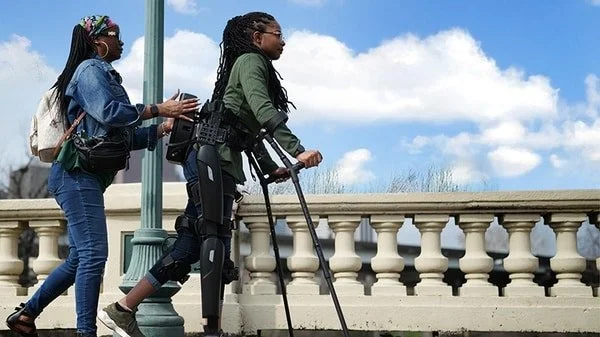
Image source: Lifeward
How Much Do Medical Exoskeletons Cost? Pricing and Medicare Coverage
Cost remains the biggest barrier to widespread exoskeleton adoption. Advanced personal systems range from $40,000 to over $100,000, placing them out of reach for most individuals without insurance support.
The most significant access development came in January 2024, when the ReWalk Personal Exoskeleton was assigned to the Medicare durable medical equipment brace benefit category. This means Medicare covers the device where medically reasonable and necessary. While coverage criteria and approval processes vary, this decision set a precedent that could open the door for other exoskeletons as clinical evidence accumulates.
Device leasing models are also lowering the barrier. In Europe, leasing reduced upfront costs for rehabilitation centers by an estimated 35% in 2025, enabling mid-tier facilities and outpatient providers to add exoskeleton-assisted therapy. Wandercraft’s anticipated Medicare coverage for Eve, if granted following FDA clearance, could further expand home-use access in the U.S.
Barriers to Exoskeleton Adoption: Eligibility, Training, and Evidence Gaps
Beyond cost, several challenges slow broader adoption.
Patient eligibility is limited. Traditional exoskeletons require adequate trunk control, sufficient bone density for weight-bearing, and the ability to tolerate standing. Older patients with spinal cord injuries often face additional challenges meeting these requirements. Self-balancing devices like Atalante X are expanding eligibility by removing the upper-body strength requirement.
Training demands are substantial. Both patients and supervising therapists need extensive instruction. A 2025 qualitative study in JMIR found that time, personnel resources, and device setup complexity were key factors limiting physiotherapists’ adoption of exoskeleton-assisted gait training.
Clinical evidence is still maturing. Early results are encouraging, but researchers emphasize that limited sample sizes in current studies make it premature to draw definitive conclusions about long-term efficacy. Larger, multicenter trials are needed to establish the evidence base that payers, regulators, and hospital systems require for broad adoption.
The Future of Robotic Exoskeletons: 2026–2036 Outlook
Within 1–3 years: Commercial availability of self-balancing personal exoskeletons like Eve. Expanded Medicare coverage. AI that adapts to individual patient needs in real time. Expect exoskeleton prescriptions for stroke recovery, multiple sclerosis, and Parkinson’s disease beyond current spinal cord injury applications.
Within 3–5 years: Lighter devices comfortable for extended daily wear. Home-delivery fitting programs that reduce reliance on specialized centers. Combination therapies merging functional electrical stimulation with mechanical support. Brain-computer interfaces will enable more intuitive control for patients with limited upper body mobility.
Within 5–10 years: Mainstream adoption in rehabilitation medicine. Neural implants may interface directly with exoskeleton control systems. Rental and subscription models will improve affordability. Self-balancing technology will be standard across all personal devices.
The open-source movement is also accelerating development. In 2025, Northern Arizona University released OpenExo, the first comprehensive open-source exoskeleton framework, making the technology freely available to researchers worldwide. This has particular promise for pediatric applications, where NAU’s Biomechatronics Lab has already helped children with cerebral palsy improve their mobility.
FAQ: Robotic Exoskeletons for Rehabilitation
What is a robotic exoskeleton?
A robotic exoskeleton is a wearable device that uses motors, sensors, and microprocessors to assist or restore human movement. In rehabilitation, these devices help people with spinal cord injuries, stroke, multiple sclerosis, and other conditions stand and walk by providing powered support to the legs, hips, and trunk.
How much does a medical exoskeleton cost?
Personal medical exoskeletons range from $40,000 to over $100,000. Rehabilitation centers typically purchase or lease clinical-grade devices, with leasing models reducing upfront costs by approximately 35%. The Lifeward ReWalk is currently covered by Medicare as a durable medical equipment brace benefit.
Does Medicare cover robotic exoskeletons?
As of January 2024, the ReWalk Personal Exoskeleton is the first exoskeleton assigned to the Medicare brace benefit category, making it covered where medically reasonable and necessary. Wandercraft’s Eve exoskeleton is expected to pursue Medicare coverage following anticipated FDA clearance in 2026. Coverage for other devices may follow as clinical evidence grows.
What conditions can robotic exoskeletons treat?
Robotic exoskeletons are currently used in rehabilitation for spinal cord injuries (the most common application), stroke recovery, multiple sclerosis, cerebral palsy, and Parkinson’s disease. Applications are expanding as clinical trials demonstrate efficacy across more neurological conditions.
What is a self-balancing exoskeleton?
A self-balancing exoskeleton uses AI and advanced sensors to maintain the user’s upright posture automatically, eliminating the need for crutches or a walker. This opens exoskeleton use to patients who lack the upper-body strength required by traditional devices. Wandercraft’s Atalante X and Eve are the most prominent self-balancing systems currently available or in development.
What Comes Next for Patients and Providers
Robotic exoskeletons for rehabilitation have moved past the proof-of-concept phase. FDA-cleared devices are operating in hundreds of clinics worldwide. Medicare coverage is expanding. Self-balancing technology is making these devices accessible to patients who were previously excluded. And companies like Wandercraft, Lifeward, and Ekso Bionics are pushing toward personal home-use devices that could fundamentally change daily life for people living with paralysis.
For rehabilitation directors and hospital administrators evaluating this technology, the most productive next step is identifying which patient populations in your facility would benefit from exoskeleton-assisted gait training and reaching out to device manufacturers for clinical demonstration programs.
For patients and families, ask your rehabilitation provider whether exoskeleton-assisted therapy is available at your facility, and check with your insurance provider about current coverage options. The Lifeward ReWalk is currently Medicare-eligible, and additional devices are expected to gain coverage in the coming years.
Stay ahead of what’s next in healthcare.
Healthy Innovations is my weekly newsletter delivering strategic analysis of emerging biotech and digital health.
No spam. Unsubscribe anytime.
